
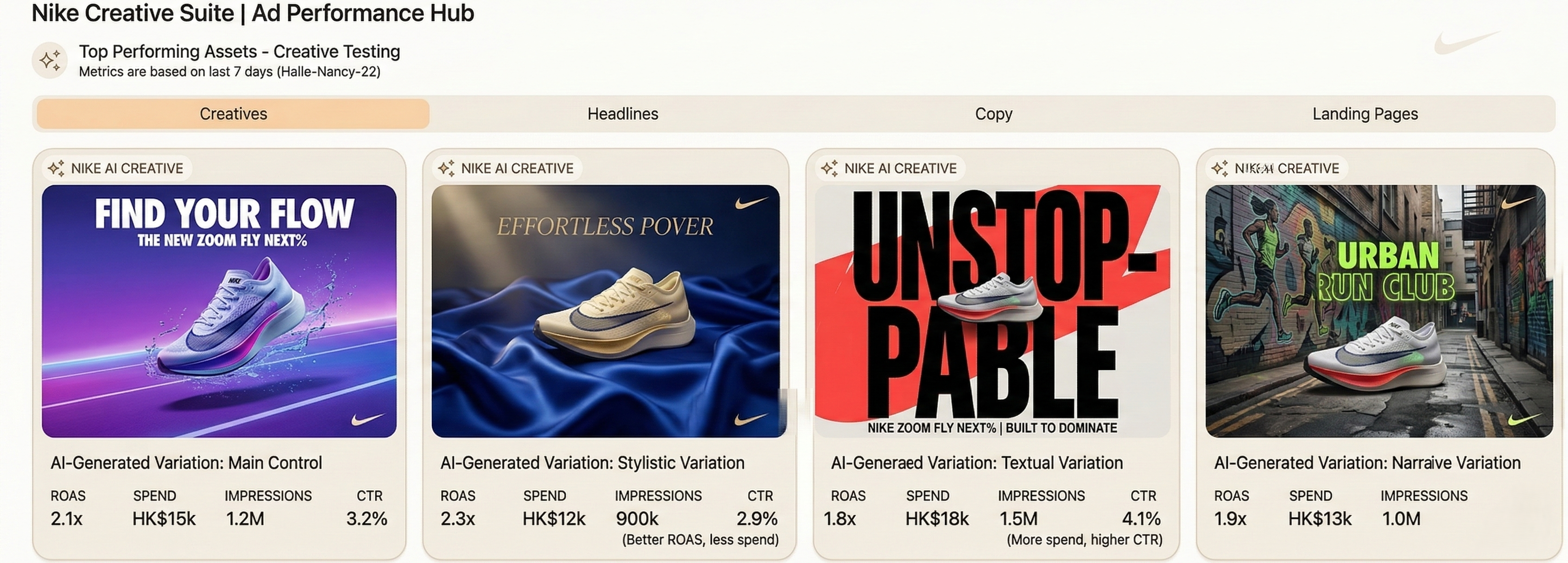
Generative AI for advertising is simultaneously the most overhyped and most underused technology in performance marketing right now. Every conference deck promises "infinite creative at scale." Meanwhile, most teams are still manually resizing banners in Figma and rewriting hooks in a Google Doc.
The gap between what AI could do for your ad creative and what teams actually use it for is enormous. This guide is about closing that gap. No theoretical hand-waving. Just practical workflows, honest assessments of what works, and a clear path from "one winning ad" to "ten testable variations" without blowing your brand apart.
The Current State of AI in Ad Creative: What Works and What Does Not
Let us start with honesty. Generative AI in 2026 is excellent at some things and genuinely bad at others when it comes to ad creative.
What works well right now:
- Image variations and style transfers. Give AI a reference image and it can generate on-brand alternatives that preserve your visual identity while exploring new compositions, backgrounds, and layouts.
- Copy and hook generation. AI is remarkably good at producing volume. Feed it a winning hook and it can generate dozens of angle variations in minutes.
- Format adaptation. Resizing and reformatting creative for different placements (Stories, Reels, feed, display) with intelligent cropping and layout adjustment.
- Video analysis and breakdown. AI can deconstruct high-performing video ads into their structural components: hook timing, pacing, scene transitions, and text overlay patterns.
What still falls short:
- Original creative concepts from scratch. AI-generated ads that start from zero tend to look generic. They lack the strategic insight a creative strategist brings.
- Brand voice nuance. Without strong guardrails, AI copy drifts toward bland, interchangeable language that could belong to any brand.
- Emotional storytelling. The best ads make people feel something specific. AI can mimic emotional structures, but the authentic spark still comes from humans.
- Legal and compliance review. AI does not understand your industry's regulatory constraints or your brand's legal boundaries.
The teams seeing real results from AI creative tools are not replacing their creative process. They are augmenting the iteration and testing phase, where volume and speed directly translate into performance gains.
Practical Use Cases That Actually Move the Needle
Forget the theoretical possibilities. These are the AI creative use cases that performance marketing teams are using today to ship more variations and find winners faster.
1. Image Variations from a Winning Reference
You have an ad that is performing well. Instead of asking your designer to manually create five more versions, you use AI to generate visual variations that preserve the core composition while testing different backgrounds, color treatments, product angles, and lifestyle contexts.
This is where tools like Glued's AI Image Variations come in. You upload your winning reference image, set your brand parameters, and generate a batch of on-brand alternatives. The AI understands what to keep (your product, your visual identity) and what to explore (setting, mood, supporting elements).
Why it matters: Creative fatigue is real. Your top performer will eventually decay. Having a pipeline of variations ready to rotate means you can extend the life of a winning concept without starting from scratch.
2. Hook and Copy Testing at Scale
The first three seconds of a video ad or the headline of a static ad determine whether someone stops scrolling. Testing hooks is one of the highest-leverage activities in paid media, but most teams test two or three variations because writing more takes too long.
AI hook generation changes the math. Feed your winning hook and your product context into a tool like Glued's Hook Variation Generator, and you get dozens of alternatives that hit different psychological angles: curiosity, urgency, social proof, direct benefit, contrarian take.
Why it matters: Hook testing is a volume game. The more angles you test, the more likely you are to find the outlier that outperforms your control by 30% or more.
3. Format Adaptation Across Placements
A creative that works in the Instagram feed does not automatically work in Stories or as a YouTube bumper. Different placements have different aspect ratios, attention patterns, and best practices.
AI-powered format adaptation goes beyond simple cropping. It intelligently repositions elements, adjusts text placement for different safe zones, and can modify pacing for different platform expectations.
4. Video Structure Analysis for Replication
When a video ad outperforms everything else in the account, the question is always "why?" AI video analysis can break down the structural elements: where the hook lands, how the pacing builds, when the product appears, how the CTA is framed.
Glued's Video Analysis Pipeline does exactly this. It gives your creative team a blueprint they can use to replicate the structure with different concepts, rather than guessing at what made the original work.
Step-by-Step Workflow: From One Winning Ad to 10 Testable Variations in 30 Minutes
Here is a concrete workflow that creative strategists and performance marketers can run today. No handwaving, just steps.
Prerequisites: One ad that has demonstrated strong performance (your control creative), access to AI variation tools, and a clear brand asset library.
Step 1: Analyze the Winner (5 minutes)
Before generating anything, understand why your control works.
- Identify the hook angle (what psychological lever is it pulling).
- Note the visual composition (product placement, background, color palette).
- Document the CTA structure and positioning.
- If it is video, map the pacing: hook duration, body structure, CTA timing.
Step 2: Set Brand Guardrails (3 minutes)
This is the step most teams skip, and it is why their AI output looks off-brand.
- Load your brand assets into your asset library (logos, fonts, color codes, product images). In Glued, this is the Brand Asset Library.
- Define what is flexible (backgrounds, supporting imagery, copy angles) and what is fixed (logo treatment, product representation, brand colors).
- Set any compliance constraints (claims you cannot make, imagery you cannot use).
Step 3: Generate Image Variations (7 minutes)
Using your winning reference image and brand guardrails:
- Generate 5-8 image variations exploring different visual contexts.
- Review and discard any that drift too far from brand.
- Select the 3-4 strongest for testing.
Step 4: Generate Hook Variations (5 minutes)
Using your winning hook as the starting point:
- Generate 10-15 hook variations across different angles.
- Filter for brand voice alignment.
- Select 4-5 that represent genuinely different approaches (not just rewording the same angle).
Step 5: Assemble Test Matrix (5 minutes)
Combine your image variations with your hook variations into a structured test matrix:
- 3-4 image variations x 2-3 hook variations = 6-12 testable combinations
- Prioritize combinations that isolate one variable at a time for cleaner testing signals.
Step 6: Launch and Measure (5 minutes to set up, then ongoing)
Upload your variations to your ad platform. Set up your test structure so you can attribute performance back to specific variation elements, not just the ad as a whole.
With Glued's Creative Performance Overlay, you can see spend and ROAS alongside creative thumbnails, making it immediately obvious which variations are pulling ahead.
Keeping Brand Consistency With AI: The Brand Asset Library Approach
The number one fear creative directors have about AI-generated ad variations is brand dilution. And it is a legitimate concern. Unconstrained AI output drifts toward generic.
The solution is not to avoid AI. It is to build a structured brand asset library that acts as a guardrail for every generation.
What belongs in your brand asset library:
- Visual identity assets: Logos (all formats), brand colors (hex codes), typography specs, approved photography styles.
- Product assets: High-quality product images from multiple angles, lifestyle shots, packaging imagery.
- Brand voice documentation: Tone descriptors, words to use, words to avoid, example copy that nails the voice.
- Compliance rules: Claims you can and cannot make, required disclaimers, industry-specific restrictions.
When your AI tools reference this library during generation, the output stays within brand boundaries. Glued's Brand Asset Library is designed for exactly this use case: it gives the AI system enough context to generate variations that your creative director would actually approve.
The key mindset shift is treating brand consistency as an input to the AI process, not a review step after the fact. Front-loading brand constraints produces better output and reduces the review cycle from hours to minutes.
Measuring AI Creative Performance vs. Human-Only Creative
You should not take it on faith that AI-assisted creative performs as well as human-only creative. You should measure it.
Here is a straightforward framework:
- Tag your creatives by production method. Label each ad as "human-only," "AI-assisted," or "AI-generated" in your naming conventions or tracking system.
- Compare on the metrics that matter. Thumb-stop rate, click-through rate, cost per acquisition, and ROAS. Not vanity metrics.
- Control for concept quality. The fairest test is AI variations of a winning human concept vs. human variations of that same concept.
- Track production cost and time. Even if AI-assisted creative performs 5% worse on average, if it costs 80% less to produce and ships 10x faster, the portfolio math still favors using it.
Most teams that run this analysis find that AI-assisted creative performs within a tight band of human-only creative on average, but with higher variance. That higher variance is actually an advantage: it means AI is more likely to surface unexpected outliers, both positive and negative.
The winning strategy is not AI or human. It is human creative direction with AI-powered iteration, backed by rigorous performance measurement.
Common Mistakes to Avoid
Even with the right tools, teams stumble in predictable ways when adopting AI for ad creative.
Do not:
- Over-rely on AI without human review. Every AI-generated variation should pass through a human who understands brand and audience before it goes live.
- Ignore brand guidelines during generation. Feeding AI a prompt without brand context produces generic output. The asset library step is not optional.
- Generate without a testing framework. Producing 50 variations means nothing if you launch them all at once with no structure to learn from the results.
- Treat AI as a replacement for creative strategy. AI accelerates execution. It does not replace the strategic thinking about what angles to test and why.
- Skip the analysis loop. The value compounds when you feed performance data back into your next round of generation. Winning patterns should inform future prompts and constraints.
Do:
- Start with your best-performing creative as the reference point.
- Build and maintain a brand asset library before you start generating.
- Test AI variations alongside human-created variations to benchmark honestly.
- Use AI to increase testing volume on the dimensions that matter most (hooks, visuals, formats).
- Review AI output for brand voice, accuracy, and compliance before publishing.

The Future of AI-Human Creative Collaboration
The teams that will win at paid media creative over the next few years are not the ones with the biggest design departments or the most expensive agencies. They are the ones that figure out the right division of labor between human creative thinking and AI-powered production.
Here is what that collaboration looks like in practice:
Humans own:
- Creative strategy and positioning
- Brand voice definition and evolution
- Concept development and storytelling
- Performance analysis and strategic pivots
- Final quality review and approval
AI accelerates:
- Variation generation from proven concepts
- Hook and copy iteration across angles
- Format adaptation across placements
- Visual exploration within brand guardrails
- Structural analysis of winning creative
This is not a story about AI replacing creative teams. It is a story about creative teams becoming dramatically more productive by using AI for the parts of the process where speed and volume matter most.
The constraint on most paid media programs is not ideas. It is the throughput to turn those ideas into testable creative and the analytical rigor to learn from every test. AI solves the throughput problem. Good tools solve the analysis problem. Human creativity remains the strategic engine.
Start Building Your AI Creative Workflow
If you have read this far and you are still manually producing every ad variation from scratch, you are leaving performance on the table. Not because AI is magic, but because the math of creative testing favors volume, and AI is the most efficient volume lever available.
Glued's Creative Intelligence studio gives you the tools to put this into practice: AI Image Variations for visual exploration, the Hook Variation Generator for copy testing at scale, the Brand Asset Library for keeping everything on-brand, and the Creative Performance Overlay for measuring what actually works.
The gap between theory and practice is smaller than you think. Pick one winning ad, run the workflow above, and see what happens. That is the best way to learn what AI creative tools can do for your specific brand and audience.