
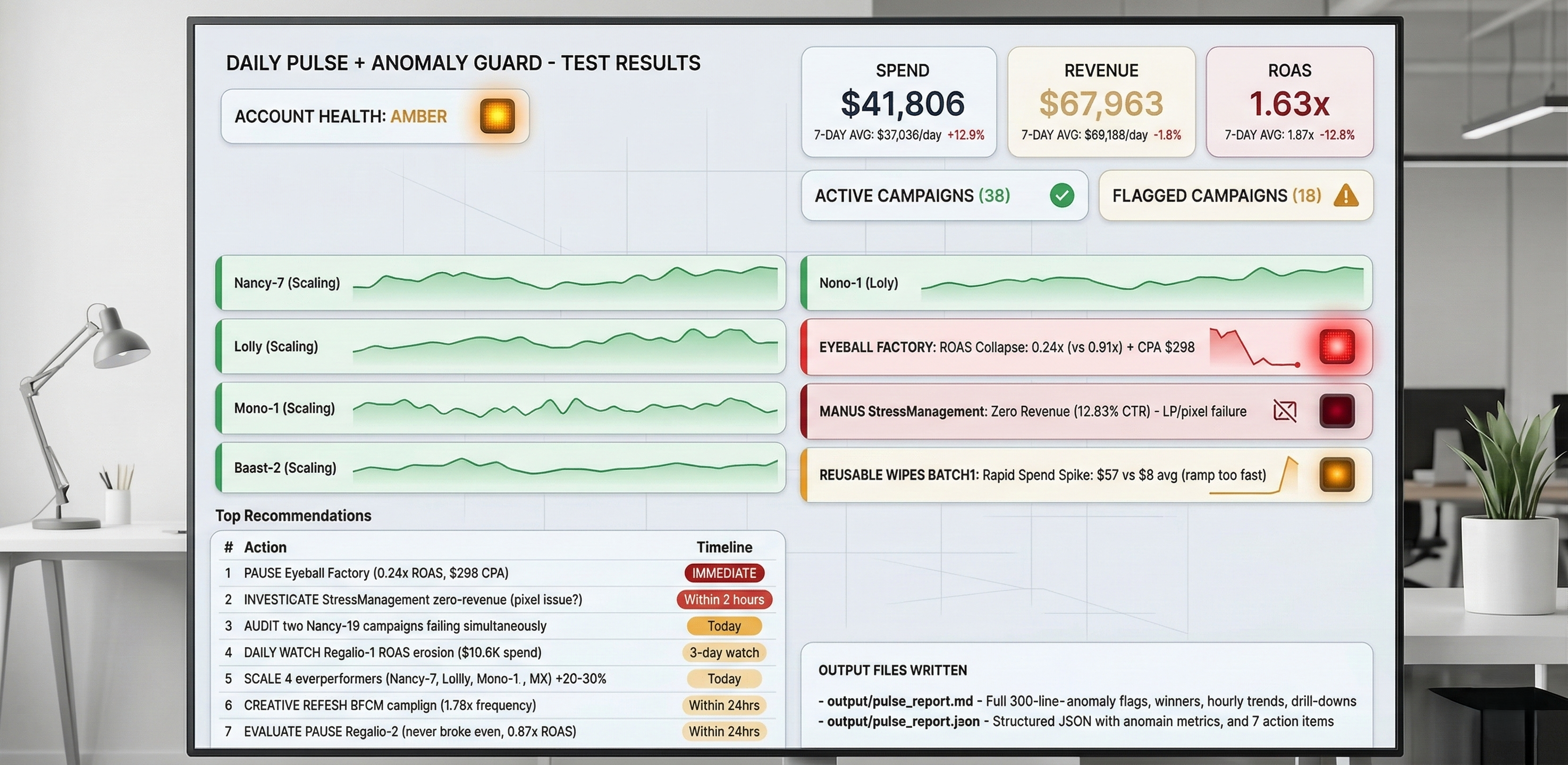
It is 9 AM on a Tuesday. You open your ad account. Everything was fine yesterday. But overnight, one campaign spiked spend by 700 percent. Another shows a ROAS of 0.12. A third --- one you paused last week --- somehow reactivated and burned through $400 on an audience that converts at zero.
You did not get an alert. Nobody flagged it. And by the time you found it, the damage was done.
This is not a hypothetical. This is a normal Tuesday for any media buyer managing more than a handful of campaigns.
Why Ad Accounts Need Daily Health Checks
Meta's delivery system is complex and occasionally unpredictable. Campaigns interact with each other. Algorithm changes roll out without announcement. Budgets get consumed at uneven rates.
In a stable account with five campaigns, you can eyeball the numbers. But as accounts scale to 15, 20, 38 campaigns or more, the surface area for anomalies grows exponentially.
Spend spikes go unnoticed. Meta allows campaigns to overspend daily budgets by up to 25%. When delivery conditions are favorable, a poorly performing campaign can consume far more than expected.
ROAS collapses hide behind averages. Account-level ROAS might look acceptable while a single campaign consuming 30% of your budget has cratered to 0.3x.
Hourly delivery patterns reveal problems. A campaign that spent its entire daily budget by 2 PM has a pacing problem. These patterns are invisible in daily aggregate data.
The Anatomy of an Anomaly
Not every fluctuation is an anomaly. An effective system compares yesterday's performance against a 7-day rolling baseline across multiple metrics:
Critical anomalies (immediate action): ROAS dropped 50%+, spend spiked 2x+, CPA spiked 2x+, or a campaign is spending heavily with near-zero conversions.
High-priority (investigate within hours): ROAS dropped 30-50%, spend spiked 1.5-2x, CTR dropped 30%+.
Medium-priority (next review cycle): ROAS dropped 15-30%, frequency exceeding 3x, conversion rate declining while clicks hold.
What a Daily Pulse Check Should Cover
A complete daily health check answers seven questions:
1. Account Health Status: Green, Amber, or Red? A single status derived from total anomaly count and severity.
2. What Flagged? Every campaign with anomaly flags, sorted by severity --- metric, current value, baseline value, percentage deviation.
3. Why Did It Flag? Context: recent budget changes? Learning phase? Market-wide cost shift? Platform issue?
4. What Does the Drill-Down Show? Ad-set-level data for the top three critical flags. A campaign ROAS collapse might have one ad set performing fine and two burning cash.
5. Hourly Trends. Front-loaded spend, sudden delivery stops, conversion lag patterns.
6. Winners and Laggards. Best and worst performers from yesterday.
7. Prioritized Recommendations. Not "optimize campaigns" but: "Reduce Campaign X budget by 30% --- ROAS at 0.4x for 3 consecutive days."
What This Looks Like With Glued MCP
Using Glued's MCP API and the Daily Pulse & Anomaly Guard skill, this entire health check runs automatically every morning. In a recent run across an account with 38 active campaigns, the system detected 22 anomaly flags --- 3 critical (including a 7x spend spike and a ROAS collapse to 0.12x), 7 high-priority, and 12 medium-priority. It computed 7-day baselines for every campaign, classified each anomaly by severity, drilled down to ad-set level for critical flags, analyzed hourly delivery patterns, and generated a prioritized 8-item action list.
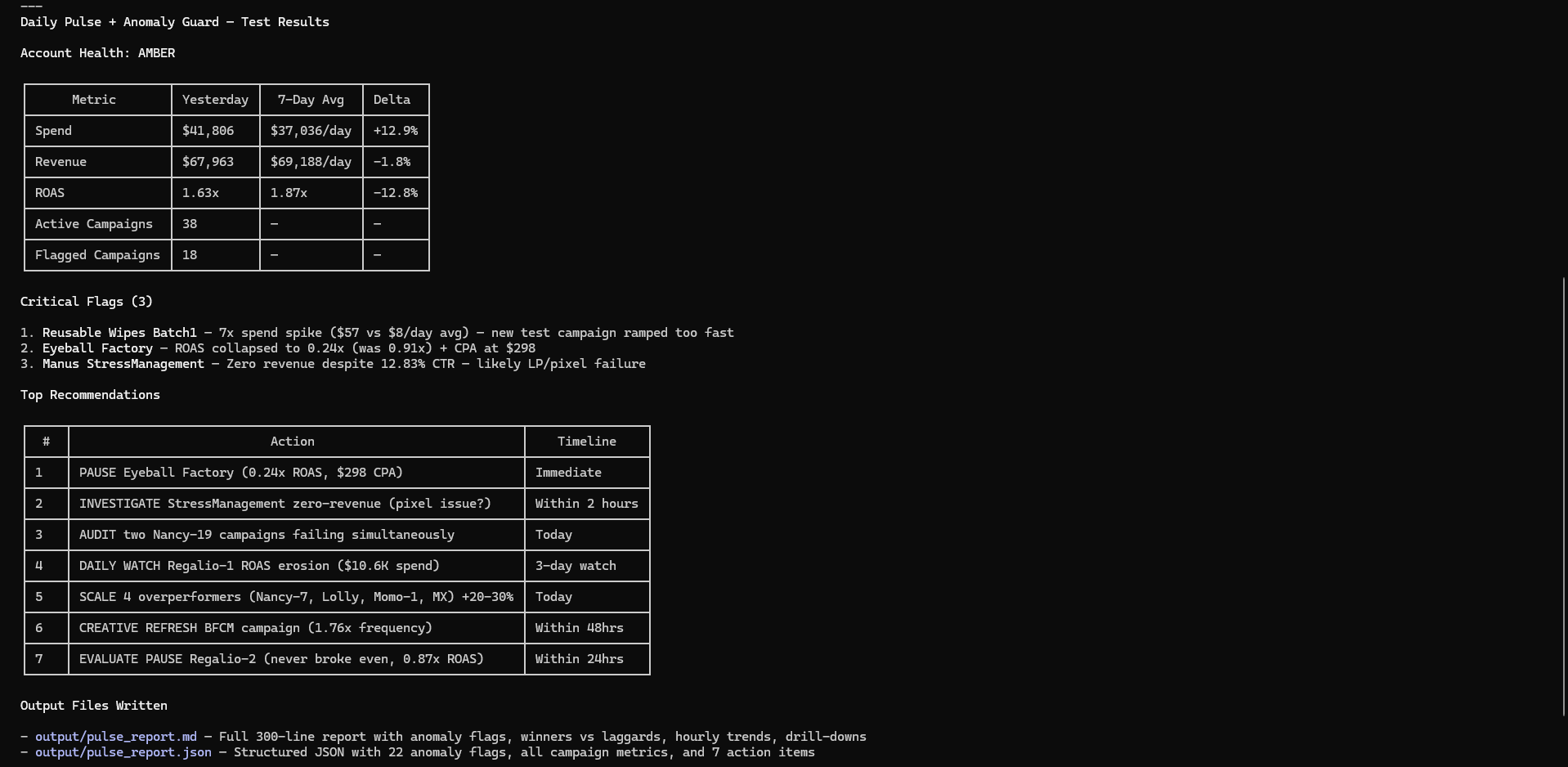
The complete report --- account health status, anomaly flags, drill-downs, hourly trends, and recommendations --- was structured for Slack delivery before the morning standup.
Building the Daily Monitoring Habit
Before 9 AM: Review the automated pulse report. If green, move on. If amber or red, prioritize investigation.
9 to 10 AM: For critical flags, dig in. Check for known causes. Take immediate action --- budget reduction, pause, or creative swap.
Afternoon (2-3 PM): Quick hourly delivery scan. Any morning anomaly resolved or worsened?
Total daily time: 15-30 minutes for a healthy account. 45-60 minutes with active anomalies. Compare that to the cost of a single undetected spend spike --- often hundreds or thousands of dollars.
The Cost of Not Watching
A single undetected critical anomaly can burn $500 to $5,000 in a single day. Over a year, missing one per month costs $6,000 to $60,000. For agencies managing multiple accounts, multiply by client count.
Daily monitoring catches problems when they are $50 issues instead of $5,000 issues. It is not glamorous. It does not feel like "strategy." But it is the single most high-ROI operational habit in performance marketing.
Ready to automate your daily ad monitoring? Glued's Campaign Health Triage and Slack digests deliver daily performance summaries with anomaly classification. The MCP API enables AI-powered anomaly detection with drill-downs and prioritized recommendations. Start your free trial at glued.me and stop waking up to surprises.