
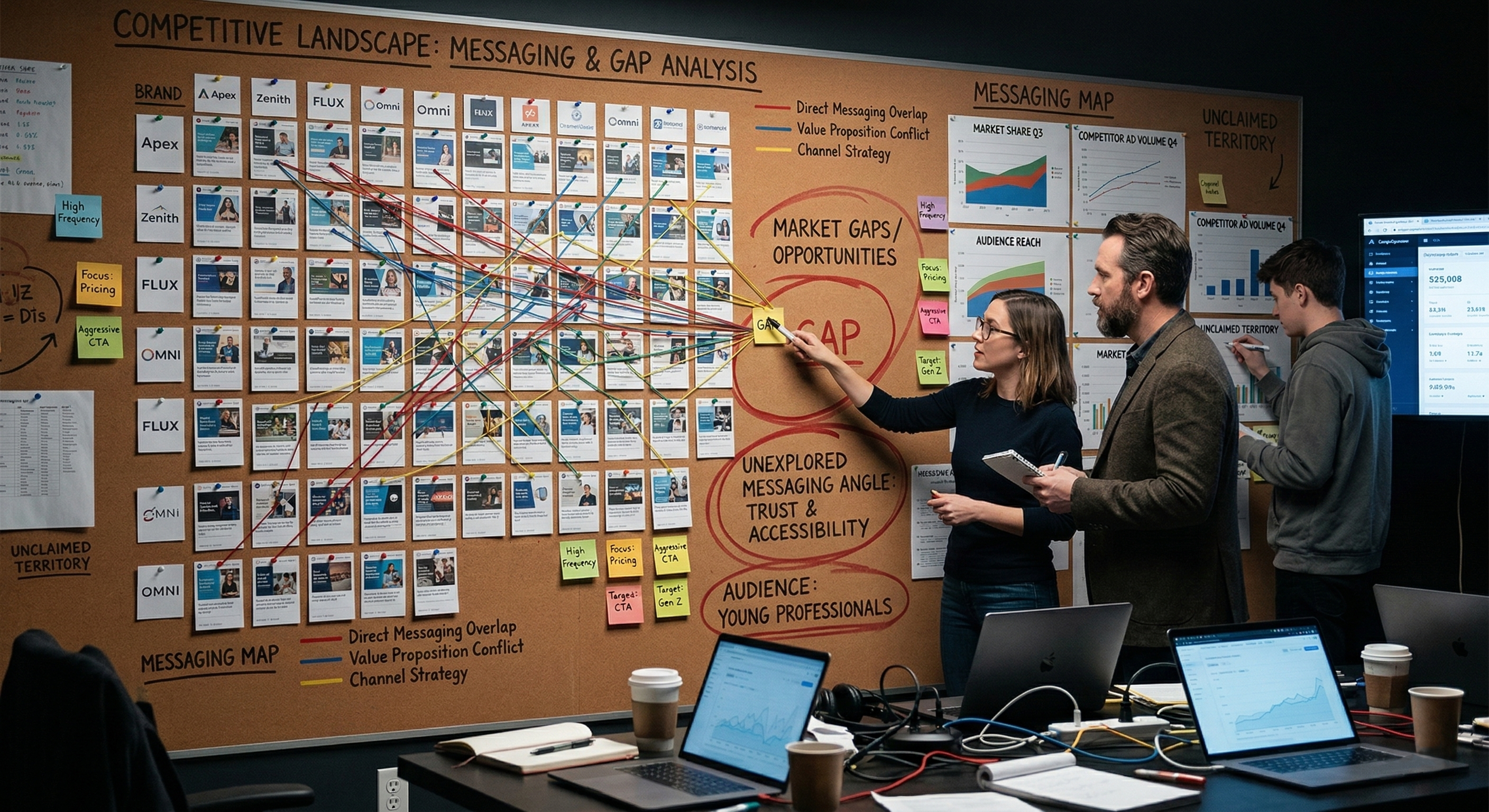
Every marketer has a swipe file. A folder of screenshots. A Slack thread from six months ago where someone posted "look what Brand X is doing."
And almost nobody does anything useful with it.
The problem is not that brands fail to look. It is that they look at the wrong layer. They see the ad --- the image, the headline, the CTA --- and react to the surface. "That looks cool, let us try something like that."
That is not competitor research. That is copying with extra steps. Real competitor creative research operates at the strategy layer: why is this ad running? What angle is it using? What gaps does it reveal? What does this tell me about what to do differently?
Why Copying Competitor Ads Fails
Context is invisible. You do not know their targeting, funnel, or whether that ad is a winner or about to be killed. Copying the visible piece without the invisible context is like copying a chess move without seeing the board.
Your brand is not their brand. An ad that converts for them might flop for you because the context --- brand equity, audience relationship, product positioning --- is different.
You are always a step behind. By the time you screenshot, brief, produce, and launch a similar version, the original insight is stale.
The alternative is to reverse-engineer the strategy and build something original.
The Four Layers of Competitive Creative Intelligence
Layer 1: What Are They Running?
Raw data. How many active ads? What formats? What platforms? What CTAs? What start dates? Necessary but not sufficient.
Layer 2: What Is Working?
Runtime is the proxy for performance. An ad active for 200 days is a validated winner --- brands do not keep paying for ads that do not perform.
| Competitor | Active Ads | Avg Runtime | Longest Runner | |---|---|---|---| | Huel | 3 | 215 days | 312 days | | AG1 | 2 | 92 days | 134 days | | Liquid IV | 6 | 43 days | 78 days |
Huel runs fewer ads for longer (finds winners and scales). Liquid IV runs more ads with shorter lifespans (aggressive testing and rotation). Two different strategies, both informative.
Layer 3: What Patterns Emerge?
Classify every ad by messaging angle, visual approach, and offer structure:
- Dominant angles. If 80% lead with authority, a non-authority angle might stand out.
- Visual patterns. Studio versus UGC. Bold text overlays versus minimal design.
- Hook structures. Questions versus statistics versus bold claims.
Layer 4: What Gaps Exist?
The most valuable layer. A recent analysis of three major supplement brands revealed:
- No social proof. Not a single competitor led with testimonials or review data.
- No transformation narratives. Nobody was showing before-and-after stories.
- No fear or consequence framing. Every ad focused on positive outcomes only.
- Zero Instagram-only placement. All competitors optimized for Facebook.
These gaps are data-driven observations that directly inform creative briefs.
What This Looks Like With Glued MCP
Using Glued's MCP API and the Competitor Research skill, the entire research pipeline runs automatically. In a recent analysis, the system scraped three competitor brands from Meta's Ads Library, classified 11 active ads by format, angle, CTA, and runtime, identified persistent winners versus active tests, mapped the strategic landscape, and surfaced 4 distinct gap opportunities --- all structured into a research report with creative briefs and a hook matrix.
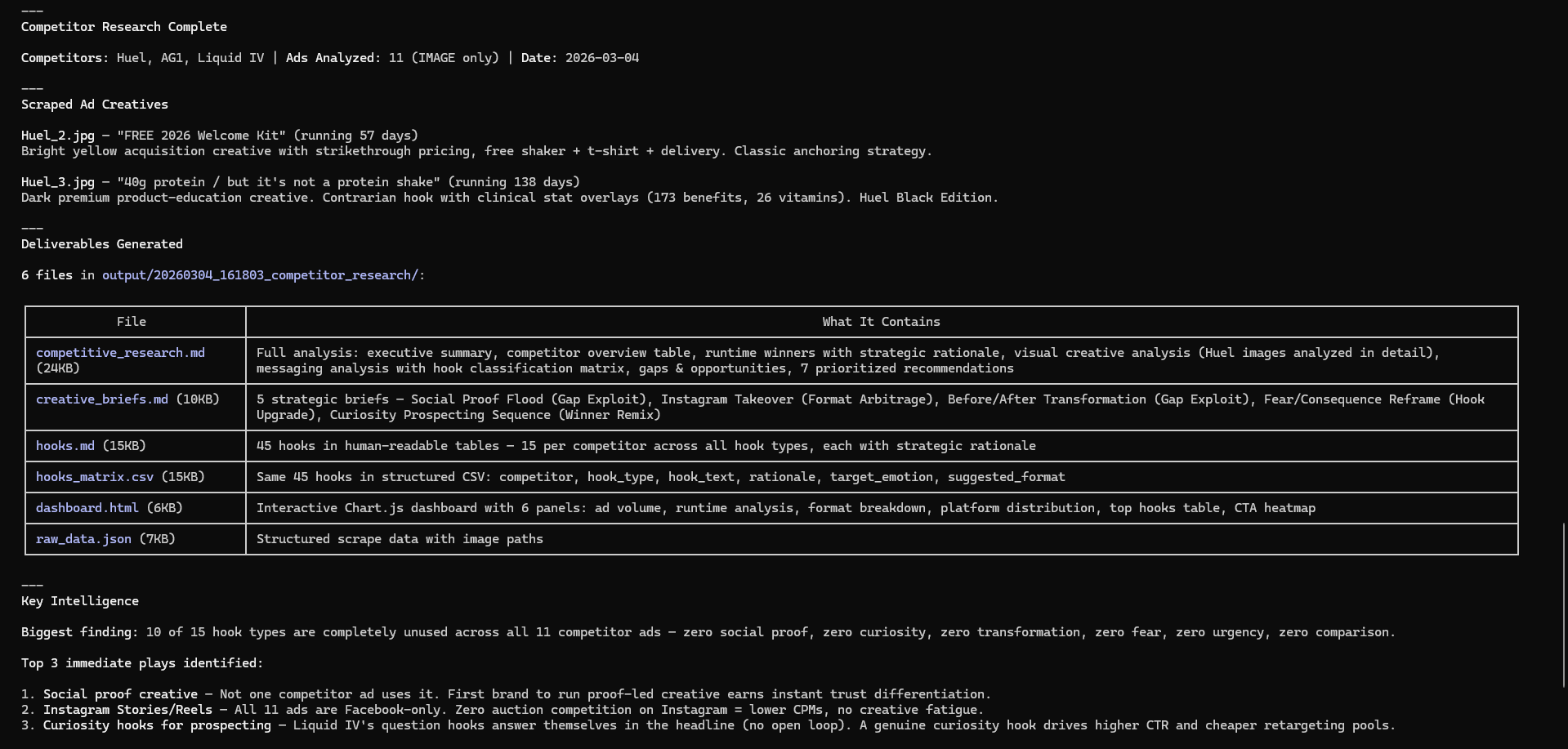
The system also generated 45 hooks across 15 hook types (curiosity, pain point, social proof, urgency, contrarian, and more) --- each tailored to a specific competitive gap with rationale explaining why the hook addresses a weakness in that competitor's approach.
From Intelligence to Creative Briefs
The endgame is not a slide deck of screenshots. It is creative briefs:
The Counter-Position Brief. If every competitor uses authority ("recommended by doctors"), counter with authenticity ("recommended by your friends who actually use it").
The Gap Exploit Brief. Fill the exact space competitors have left empty. No competitor uses social proof? Build a UGC video campaign heavy on testimonials.
The Winner Remix Brief. Take a competitor's proven 200+ day winner and create your version using your brand assets and customer proof points. Not copying --- recognizing a proven angle and bringing your own version.
The Format Arbitrage Brief. When competitors cluster around one format, there is often less competition and lower costs in underused formats.
The Hook Upgrade Brief. If competitors lead with vague curiosity ("You will not believe this"), counter with specific curiosity ("The one ingredient 94% of supplements leave out").
Making This Repeatable
Monthly: Run a full competitive scan. Update classifications. Identify new ads, retired ads, runtime changes.
Quarterly: Produce a trend report. Identify macro shifts in format, messaging, and offer strategy. Update your creative brief backlog.
Per campaign launch: Run a targeted competitive scan to ensure your creative direction is differentiated from what is currently in market.
Stop Collecting Screenshots. Start Collecting Intelligence.
The brands that consistently produce winning creative are not the ones with the biggest budgets. They are the ones with the best information.
When you know what every competitor is running, how long it has been running, what angles are dominant, and where the gaps are --- you make better creative decisions. Not because you copy what works, but because you understand the landscape well enough to do something different.
Ready to systematize your competitive research? Glued's Ad Library Browser, automated competitor monitoring, and MCP API let you run structured competitive analysis on any schedule. Save references to Inspiration Boards, track changes over time, and feed data into AI-powered analysis workflows. Start your free trial at glued.me and turn competitor watching into a competitive advantage.