
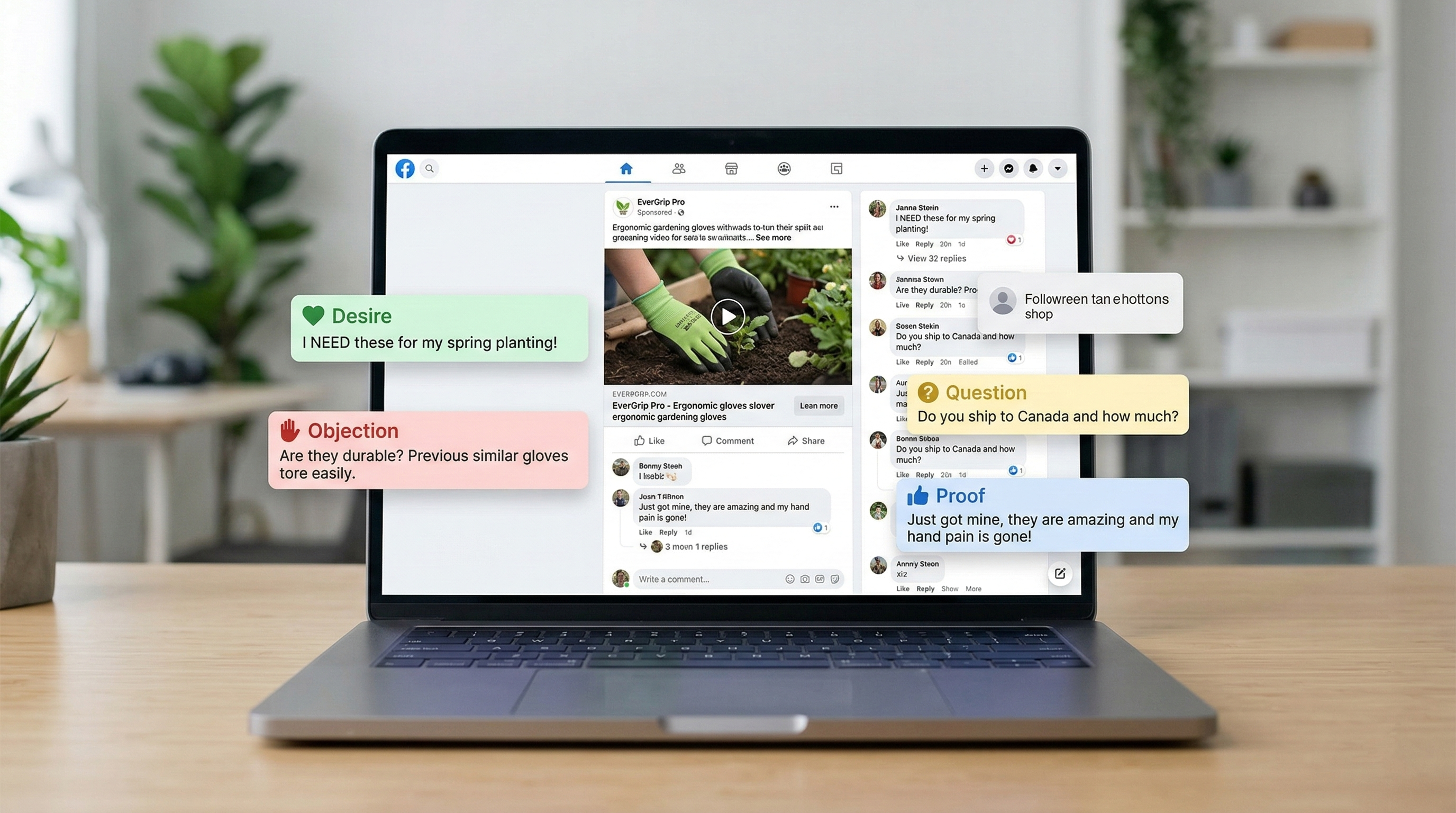
There is a focus group running 24 hours a day on your brand's Facebook and Instagram ads. It is brutally honest, completely unsolicited, and you are probably ignoring it.
Every time you launch an ad, your comment section fills up with real people telling you exactly what they think. They raise objections your sales page never addresses. They compare you to competitors you have never considered. They ask questions that reveal fundamental gaps in your messaging. And occasionally, they hand you headline-ready copy angles on a silver platter.
Most brands treat ad comments as a nuisance --- something to moderate, not to study. That is a mistake. While you spend thousands on surveys and user interviews, the rawest customer feedback you will ever get is sitting right there in your comment threads, unread and unanalyzed.
Why Ad Comments Reveal What Surveys Never Will
Surveys suffer from a well-documented problem: people perform. They give the answer they think you want.
Ad comments are the opposite. They are impulsive, unfiltered, and written in the heat of the moment. A person scrolling through their feed sees your ad, has a gut reaction, and types it out before their internal editor kicks in.
What makes ad comments uniquely valuable:
- They capture first impressions. The reaction to your messaging before any nurturing or sales process.
- They surface real objections. Not the objections you brainstormed in a meeting, but the ones that actually stop people from buying.
- They reveal language patterns. Your customers describe their problems in their own words --- words you should be using in your copy.
- They expose competitive positioning. People openly compare you to alternatives, telling you exactly where you sit in their mental landscape.
The problem is not that this data does not exist. It is scattered across dozens of ad sets and thousands of individual comments. Extracting anything useful manually is a full-time job.
The Signal Hidden in the Noise
Not every comment is useful. A typical ad with decent engagement contains a predictable mix of signal and noise. Emoji-only reactions, friend tags with no context, bot spam --- on a post with 200 raw comments, you might find only 150 to 170 that are actionable.
The signal breaks into four categories:
Objections --- comments expressing doubt or a specific reason not to buy. "Looks cool but I bet the shipping takes forever." These are the most strategically valuable comments, because each represents a purchase barrier your marketing needs to address.
Desires --- expressing wanting or excitement. "I need this for my kitchen." These tell you which emotional triggers work and which use cases resonate.
Proof --- social validation, unsolicited testimonials. "I bought this three months ago and it changed my routine." Screenshot these, catalogue them, and repurpose them everywhere.
Risk signals --- clusters of complaints about unfulfilled orders or unresponsive support that indicate systemic problems before they show up in return rates and chargebacks.
From Comments to Clusters: Where the Real Insights Live
Individual comments are anecdotes. Clusters are data. Here is what a real analysis looks like --- 170 actionable comments from a DTC brand across 4 pages over 7 days, clustered by theme:
| Theme | % of Comments | Category | |---|---|---| | Game-changer endorsements | 16.5% | Proof | | Competitor comparisons | 8.2% | Objection | | How-does-it-work questions | 6.5% | Objection | | Ad copy confusion | 4.7% | Risk | | Couples/partner gifting intent | 4.1% | Desire | | Bot/AI suspicion | 3.5% | Objection | | Price objections | 3.5% | Objection | | Product defect reports | 3.5% | Risk | | Shipping delay complaints | 2.9% | Risk |
That table is a strategic roadmap. It tells you: your social proof is strong (amplify it), you have a messaging clarity problem (fix it immediately), a fulfillment issue is brewing (escalate it), and a significant chunk of your audience needs competitive differentiation (create ad variations addressing it head-on).
What This Looks Like With Glued MCP
Using Glued's MCP API and the Comment Insights Engine skill, this entire analysis runs automatically from live page data. In a recent run, the system pulled 200+ raw comments across 4 Facebook pages, filtered noise (emoji-only reactions, tags, spam), classified 170 actionable comments into objections, desires, proof, and risk signals, then clustered them into 11 distinct themes --- complete with percentage breakdowns, copy angle suggestions, and ready-to-use reply templates.
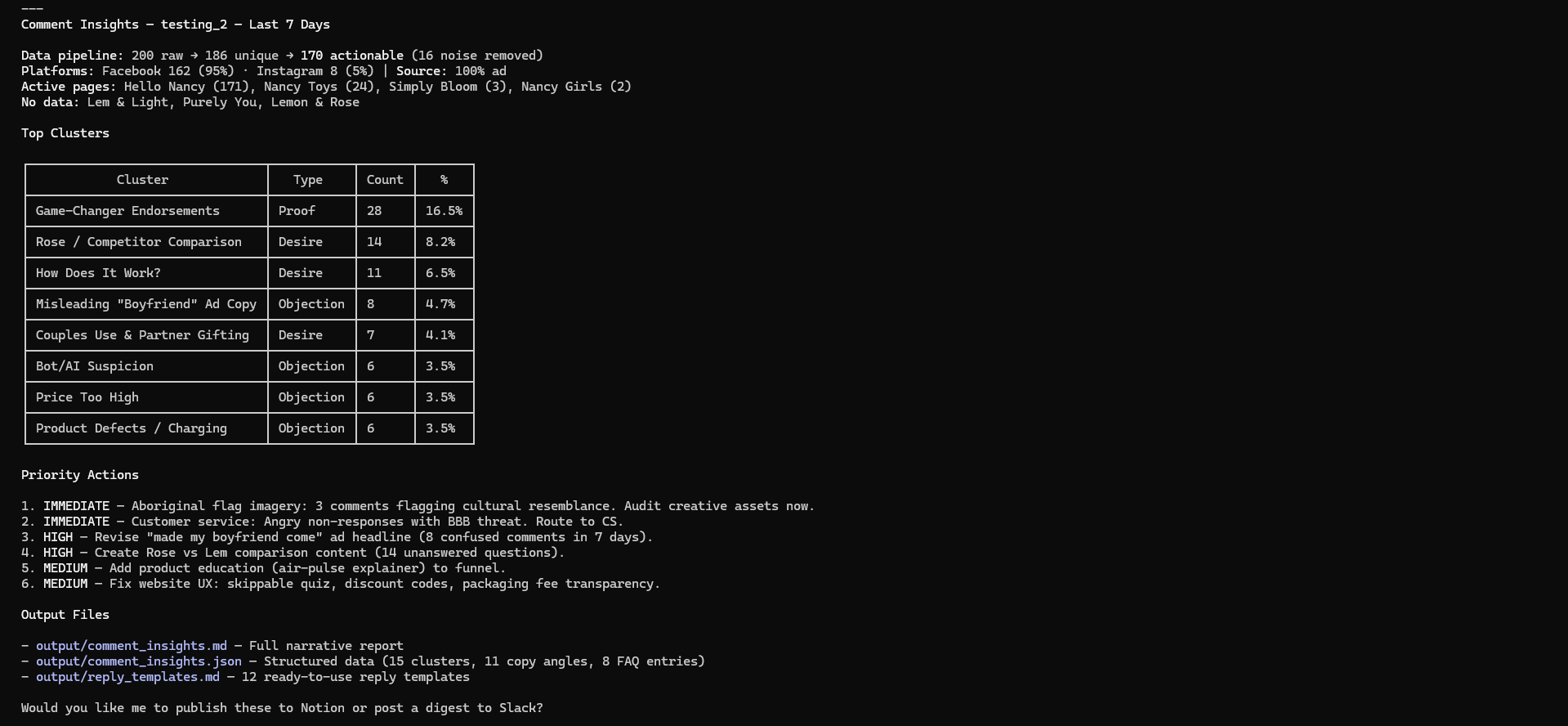
The output included 11 copy angle suggestions derived directly from comment themes and 12 brand-voice reply templates covering every major cluster --- from competitor comparison responses to shipping complaint escalation scripts.
Turning Clusters Into Copy Angles
Each cluster produces copy angles --- headline-ready hooks your customers have already told you they care about:
- From competitor comparisons: "Why 3 out of 4 people who tried [Competitor] switched to us"
- From how-does-it-work questions: "Here is exactly how it works (60-second explainer)"
- From gifting intent: "The gift they will actually use every day"
- From price objections: "Less than $2 per day for [benefit]"
- From repeat purchase proof: "Why 40% of our customers reorder within 60 days"
A single analysis can yield 10+ copy angles, each grounded in real customer language rather than creative brainstorming.
Reply Templates: Turning Defense Into Sales
A significant portion of purchase-intent comments on most brand ads go completely unanswered. Someone writes "How do I buy this?" and nobody responds.
Every unanswered objection in your comment section is a public, visible reason not to buy. When someone writes "I ordered two weeks ago and still have not received it" and your brand says nothing, every subsequent reader absorbs that as a data point.
For each major cluster, you need a primary reply, two to three variants (so responses do not look robotic), and an escalation trigger for comments needing human intervention.
The brands that treat their comment sections as a customer service and sales channel --- not just a moderation task --- see measurably better ad performance. Comment engagement signals to the platform algorithm that your content generates meaningful interaction, which typically results in better delivery and lower costs.
Building a Repeatable Process
Weekly: Scan new comments across active campaigns. Flag emerging themes. Respond to high-priority comments using your template library.
Monthly: Run a full classification and clustering analysis on the past 30 days. Update your copy angle bank and reply templates.
Quarterly: Compare comment themes across time periods. Are objections shifting? Are new competitors being mentioned? Use trend data to inform next quarter's creative strategy.
Per campaign launch: Within 48 to 72 hours of a new campaign, closely monitor comments for unexpected reactions. Early comment patterns are your fastest feedback loop --- faster than conversion data, faster than ROAS calculations.
The Comments Are Talking. Start Listening.
The difference between brands that struggle with ad performance and brands that consistently improve is often not budget or creative talent. It is feedback loops.
Your customers are telling you what they want. They are telling you what scares them. They are writing your next headline, drafting your FAQ page, and flagging your operational problems before they become crises.
All you have to do is listen. Systematically.
Ready to turn your ad comments into actionable insights? Glued brings all your Facebook and Instagram page comments into one inbox, with automated Slack alerts and export tools. The MCP API powers AI-driven comment analysis that classifies, clusters, and generates copy angles and reply templates automatically. Start your free trial at glued.me and discover what your customers have been telling you all along.